The Government Shutdown

The government shutdown unfolding right now isn’t an isolated event. It’s the aftershock of the so-called Big Beautiful Bill — a sweeping act that tied together immigration control, digital surveillance, and federal funding in ways few yet grasp.
The fight over how to pay for what that bill created , and what it quietly cut , has choked the flow of money through federal veins, and once again the poor and working class are the first to bleed.
Tucked inside that bill is the next generation of biometric enforcement.
Under its mandates, facial, iris, and even behavioral recognition programs receive unprecedented expansion.
It is sold as “security” —
A tool to track criminals and manage borders yet the structure of the system is far broader.
It grants the government, through multiple agencies, the ability to identify, catalogue, and monitor not just foreign entrants but every person tied to its digital record.
The architecture for total identification now exists; all that remains is the moment when access to food, travel, or healthcare becomes contingent on that identity.
Meanwhile, the shutdown has done what no foreign adversary could…it has stopped the nation’s safety nets.
SNAP, the food benefit relied on by more than forty million Americans, is suspended or delayed as legal battles unfold over whether emergency funds can even be released.
Shelves are still stocked, but the cards that buy the groceries are frozen.
For families already at the margins, the bureaucracy itself has become the new famine.
It’s not that the bill orders this starvation directly; rather, it creates the conditions in which those in power can decide who eats and when.
In that sense, hunger becomes an administrative tool, a pressure valve, a way to remind the public who controls the gates of provision.
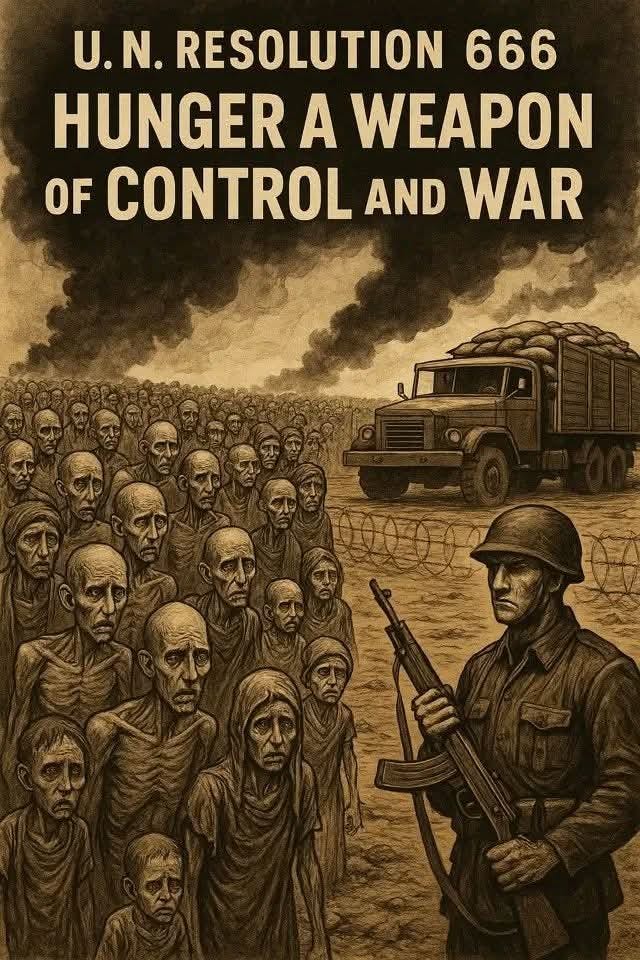
Long ago, during the first Gulf War, the United Nations wrote Resolution 666, a measure literally using food restrictions as a mechanism of war.
Was the number 666 a coincidence or Providence—but the principle has always been the same: starvation as leverage.
Now, those same patterns reappear not in Baghdad but in Washington. More on this later…
We see the fusion of two levers — the control of identification and the control of sustenance.
One determines who you are, the other determines whether you eat.
The union of those powers is not merely political; it is moral and spiritual, a mirror of the systems Daniel and John saw rising from the sea.
Whether one reads it as prophecy or simply as history repeating itself, the picture is chilling.
What we are witnessing is the birth of a new kind of governance — one that governs not by decree but by database, food and access to healthcare .
The face becomes the passport, the card becomes the breadline, and the line between citizenship and compliance grows thin as a thread.
The tools are already here, humming quietly in the machinery of bureaucracy, waiting for a moment of crisis to justify their full use.
In Revelation 13, and the rise of the Beast, Scripture warns of an age when buying and selling, life and livelihood, will all hinge on allegiance to a central authority, related to a singularity in technology and identity where the government can control society through uniformly drastic measures under a dictatorship.
It may not yet be that day, but the scaffolding is unmistakably in place.
The prophets called it the time of testing; modern language calls it “policy.”
But whatever we name it, the end is the same — a world where freedom gives way to surveillance, and mercy to nobody.
U.N. Security Council Resolution 666
In August 1990, as the world prepared for the Gulf War, the United Nations adopted Security Council Resolution 666.
The number startled readers even then, but the text was bureaucratic, framed as a humanitarian safeguard.
It decreed that food and medical supplies to Iraq and occupied Kuwait would be strictly regulated, permitted only under U.N. supervision to prevent “hoarding” and “misuse.”
In practice, it meant that the flow of food itself became an instrument of war.
Nations that controlled the shipping lanes also controlled who would eat.
For the first time in modern international law, starvation was formalized as an acceptable instrument of control.
Resolution 666 spoke the language of compassion — ensuring that aid reached civilians and not combatants — but beneath the legal phrasing lay a chilling principle: access to food could be rationed according to obedience.
It was a subtle redefinition of warfare itself.
The weapon was no longer the bullet, but the blockade.
The enemy was not simply an army, but a population judged unworthy of provision.
The policy was justified as moral necessity, but it set a precedent that still echoes today.
If an international body could decide, in the name of peace, who deserved to eat, then the line between justice and tyranny had already been crossed.
Every sanction since has drawn on that precedent — restricting supplies, freezing bank accounts, and sealing borders, all in the name of order.
Yet the invisible cost is always hunger, the slow death of the innocent while governments congratulate themselves on restraint.
Resolution 666 thus became more than a wartime directive.
It became a template for managed famine, an administrative mechanism by which compliance could be purchased through scarcity.
Once adopted, the principle never disappeared.
It evolved into the logic of sanctions, embargoes, and, eventually, digital control over trade and currency.
Today, food security is data security; supply chains are monitored through satellite and algorithm; and the same logic that once rationed grain in the Persian Gulf now governs global logistics.
Hunger has become a function of policy — predictable, measurable, and, when convenient, enforceable.
That is the prophetic edge of the matter.
The ancient prophets described a time when commerce itself would be governed by a mark — a system that distinguishes those permitted to buy and sell from those condemned to hunger.
Resolution 666 was not the fulfillment of that vision, but it was the scaffolding and rehearsal.
It taught the nations that control of bread is control of man.
A starving people can be broken faster than a conquered one; an empty stomach obeys without debate.
The ancient Assyrians employed sieges against Israel as a means of warfare- this is the origin.
When modern powers now discuss “digital food access,” “biometric ration cards,” and “supply governance,” they speak in the same tone that once justified that resolution.
They use humanitarian language, but their goal is management, not mercy.
The levers of control are no longer embargoes but databases — yet the end is the same. Those who hold the keys to distribution hold the keys to dominion.
And so the document numbered 666 stands as both symbol and seed.
It revealed how the machinery of the world can turn even compassion into coercion, and how easily the promise of peace conceals the architecture of control.
The prophets warned that in the last days the instruments of trade would become instruments of tyranny.
The world learned then that the simplest way to rule men is not to kill them — it is to feed them only when they kneel.
- Rene Bonde
- Me Ballen